Food truck course: what training is actually required?
Food hygiene training, HACCP, hygiene passports, alcohol exams: what the law really requires in Ireland and across Europe, and what is simply good advice.
 Romain BarreauFounder of Food Truck Store · 5 min read
Is there a compulsory food truck course? In Ireland, Denmark, Sweden and Spain, no particular course is compulsory: EU law says food handlers must be supervised and instructed or trained in food hygiene, but it sets no minimum hours and no diploma. Some countries go further: Finland has its hygiene passport, and Norway makes the manager sit an exam. This guide sets out what the law really requires in each country, and what is simply good advice.
What EU law requires of everyone.
Every food business operator must make sure that food handlers are supervised and instructed or trained in food hygiene to a level that suits their work, and that whoever runs the HACCP-based procedures is trained in HACCP principles (Regulation (EC) 852/2004, annex II, chapter XII). The regulation sets no minimum number of hours, and national law is free to add its own training programmes. Allergens are part of this too: when food is sold without packaging, as it is from a food truck, allergen information is mandatory (Regulation (EU) 1169/2011, art. 44).
Instructed or trained to match the job.
Ireland: adequate training, no set course.
In Ireland, every food handler, including seasonal and part-time staff, must be adequately supervised, instructed and/or trained in food hygiene, and the people responsible for HACCP procedures must be adequately trained in its principles (FSAI, Guidance Note 16, section 4.3.13). The HSE advises food businesses on what counts as adequate training, and the FSAI publishes its own Guide to Food Safety Training. None of this guidance prescribes a course lasting a set number of hours.
- List who does what
Who prepares food, who runs the HACCP procedures and who only serves at the counter.
- Train for each role
Supervision and instruction for some, food hygiene training for others, and HACCP training for whoever leads.
- Keep records
Note who was trained, on what and when, so you can show the environmental health officer.
How the rules differ by country.
Denmark and Sweden are explicit: no particular hygiene course is compulsory, provided staff have the knowledge their work calls for (Danish hygiene guidance, point 23, Livsmedelsverket). Spain abolished its compulsory food handler card in 2010 and made each operator responsible for training its own staff (Royal Decree 109/2010). Finland, Norway and Italy ask for more (Ruokavirasto, Oslo kommune, Legislative Decree 59/2010, art. 71).
- FinlandAnyone who handles perishable, unpackaged food needs a hygiene passport once that work adds up to three months.
- NorwayThe manager of every serveringssted, or food outlet, must pass the etablererprøven; in Oslo the exam is in Norwegian only.
- ItalySelling food takes a professional qualification: a regionally recognised course, two years’ experience in the last five, or a diploma.

Alcohol comes with its own exam.
In some countries, serving alcohol means passing a test as well. In Norway, the manager and deputy manager of a licensed outlet must prove they know the Alcohol Act, unless the licence covers a single occasion (Alkoholloven, § 1-7c); in Finland, the licence holder’s representative needs an anniskelupassi, which means sitting an exam (LVV); in Sweden, the applicant must pass a test on the law (City of Stockholm). Our guide to selling alcohol from a food truck sets out the rules country by country.
- 0 hoursof hygiene training set by EU law, though national law can add some
- 3 monthshandling perishable, unpackaged food before Finland requires a hygiene passport
- 2 yearsof experience in the last five: one route to Italy’s food qualification
Learn on the job first.
Courses sold as “food truck training” are private, and none of the countries in this guide requires one. Before you pay for one, list what you can already do: cooking in volume, running a till, putting together a cash flow forecast.
Train before you choose your layout.
Do your food hygiene training before you settle on a layout, not after. What you learn about forward flow, keeping clean and dirty apart and holding temperatures decides where your cold storage, sink and worktop go. That is exactly what we go through with you on the trailer plan.
Then run the numbers: the free FTS Academy quiz finds the right layout for your menu, and our guide on how to start a food truck business shows where training fits among the other steps.
Trained, registered and ready to serve.
Training is only one step, alongside registering your food business and getting your trading licence. Read our food truck licence guide, then take a look at our food truck trailers: from €11,500 excl. VAT, with stainless steel worktops and an automatic sink.
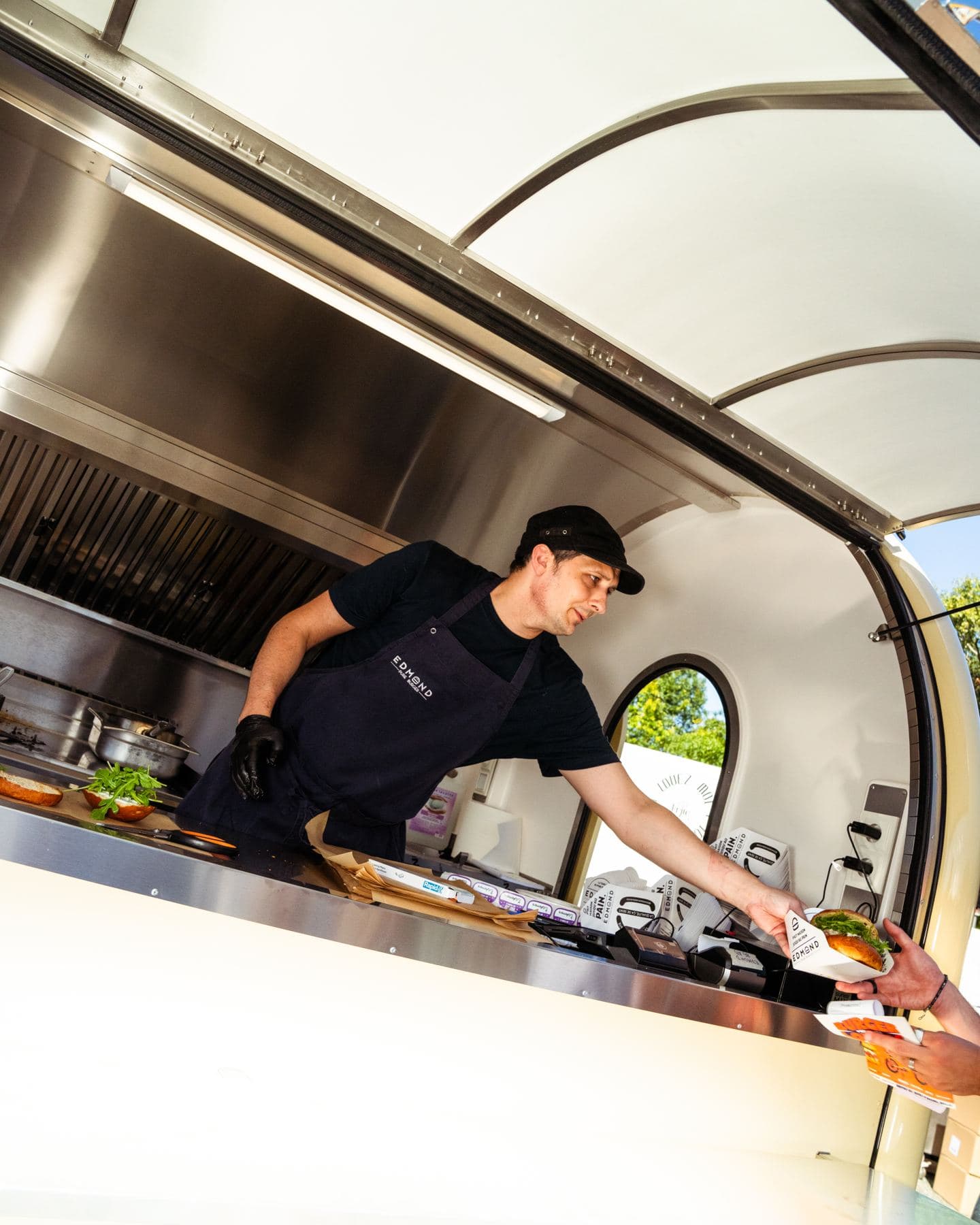
Good hygiene shows at the counter, shift after shift.
Your questions answered.
Got another question? Just ask us ›Not as such. EU law requires food handlers to be supervised and instructed or trained in food hygiene, and the person leading HACCP to be trained in its principles, but it sets no minimum hours. Some countries add their own requirements: a hygiene passport in Finland, an exam for the manager in Norway and a professional qualification in Italy.
Training that is adequate for each person’s work: food handlers must be supervised, instructed and/or trained in food hygiene, and whoever is in charge of your HACCP procedures must be trained in its principles. The HSE can advise on what is adequate for your business.
Your food safety procedures must be based on HACCP principles, and whoever develops and runs them must be adequately trained in those principles. Whether anyone else needs formal training depends on their role and on your country.
Yes, if you handle perishable, unpackaged food: you need one once that work adds up to three months, and the rule covers employers too.
In some countries, yes. Norway requires the manager of a licensed outlet to prove knowledge of the Alcohol Act, Finland requires an anniskelupassi for the licence holder’s representative, and Sweden makes the applicant pass a test on the law.
None of the countries in this guide requires one, and in Italy only a regionally recognised course counts towards the qualification. Compare the syllabus with what you already know, and spend a day working alongside an operator first.
 By Romain, founder