Mini food truck: small trailer, cart or van?
Cart, three-wheeler, van or small trailer: what each kind of mini food truck can really do, the rules in each country, and our AIR 220 in detail.
 Romain BarreauFounder of Food Truck Store · 5 min read
A mini food truck is a way to start small: a modest budget, a category B licence and a pitch that is easier to find. But a cart, a three-wheeler, a van and a small trailer do not let you trade in the same way. This guide explains what each one can do, then looks at our AIR 220 trailer in detail.
Four kinds of mini food truck.
All four sell food from a very small space, but the right one depends on what your menu needs in terms of cooking, water, refrigeration and power. Cities treat them differently too, as in Copenhagen and Helsinki.
- The food cartPedal-powered or electric, it carries a counter, a little water and a little power: fine for coffee, drinks or ice cream, rarely for hot food. In Copenhagen, a cargo bike or a handcart can stand on squares and wide pavements.
- The three-wheelerIt catches the eye, but the body is narrow: a short menu, and little room for water or refrigeration. In Helsinki, you can sell from a bicycle, a cart or a class L1e or L2e moped without a permit, if you stay no more than one hour in one place and set nothing up on the ground.
- The small vanEngine and kitchen in one vehicle: when the van goes to the garage, the kitchen goes with it.
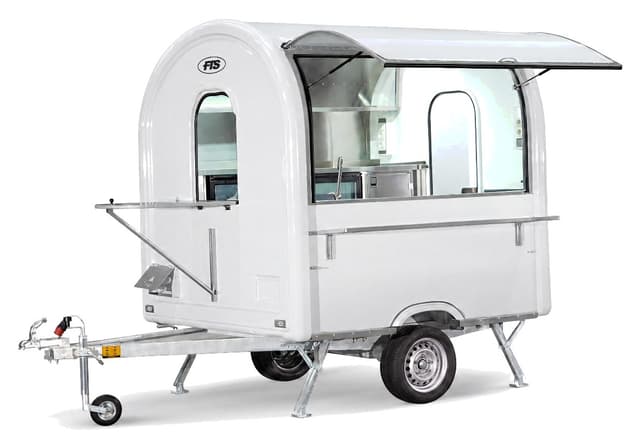
- The small trailerA real kitchen on one axle, with no engine: your car drops it off on the pitch and drives away. In Copenhagen, a trailer with a number plate can only use parking spaces.

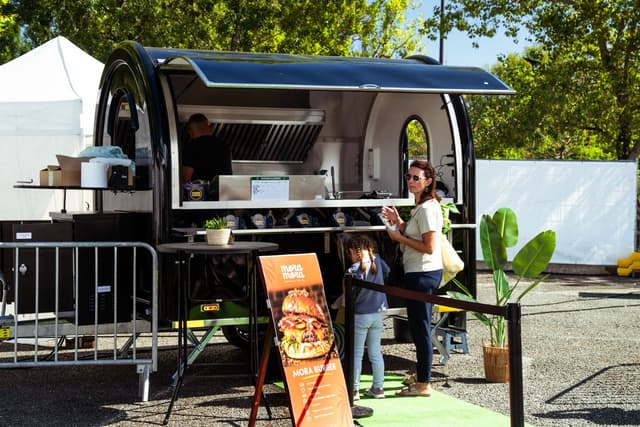
Small trailer, same hygiene rules.
EU hygiene rules also cover mobile sales vehicles. Water and hand washing are often where the smallest formats reach their limits (Regulation (EC) 852/2004, annex II, chapter III, FSAI, Guidance Note 16, 4.3.5).
- Hand washing
Where necessary, facilities for washing and drying hands hygienically: running water, soap and disposable towels. In Ireland, the FSAI expects a wash-hand basin with running hot and cold or warm water wherever high-risk food is exposed. A hot-water hand basin is an option on our trailers.
- Fresh and waste water
Enough drinking water to last the whole service (in Ireland, the FSAI recommends a container of at least 20 litres), and a covered container for waste water.
- Refrigeration and monitoring
Enough fridge space to keep food at the right temperature, and a thermometer in each fridge to monitor it.
- Cooking
An extractor hood as soon as you grill or fry, and gas installed and inspected by a qualified professional in your country.
The AIR 220 in figures.
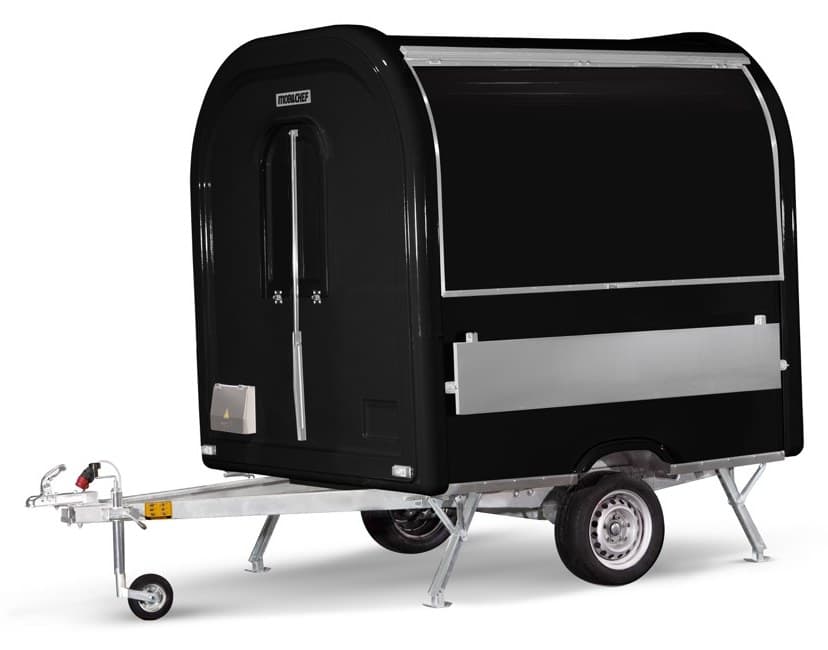
This is our compact format: a 220 cm body on a single unbraked axle, with 211 cm of headroom so you can work standing up. Our guide to food truck dimensions compares its measurements with the BOLD 270.
- 361 cmlong, including the drawbar
- 203 cmwide
- 262 cmhigh: the figure to check for your garage
- 750 kgmaximum authorised mass, towable on a category B licence
Four layouts on the same base.
All four layouts are available in the AIR 220 on the same base: a fibreglass body, stainless steel worktops, an automatic sink and 230 V wiring, with the gas bottle box as an option. Compare them on our comparison page.
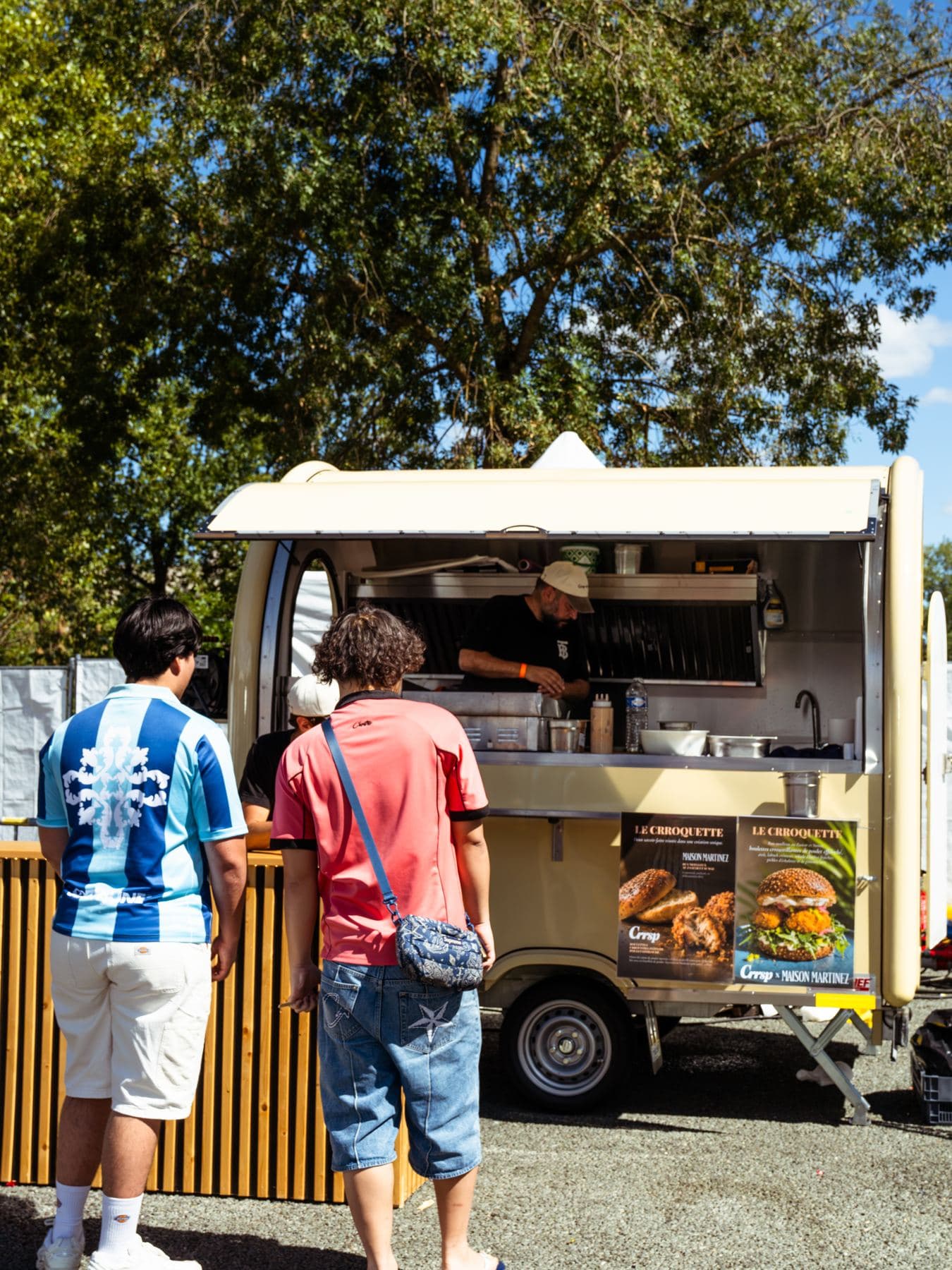
Unhitched, legs down, hatch open: time to serve.
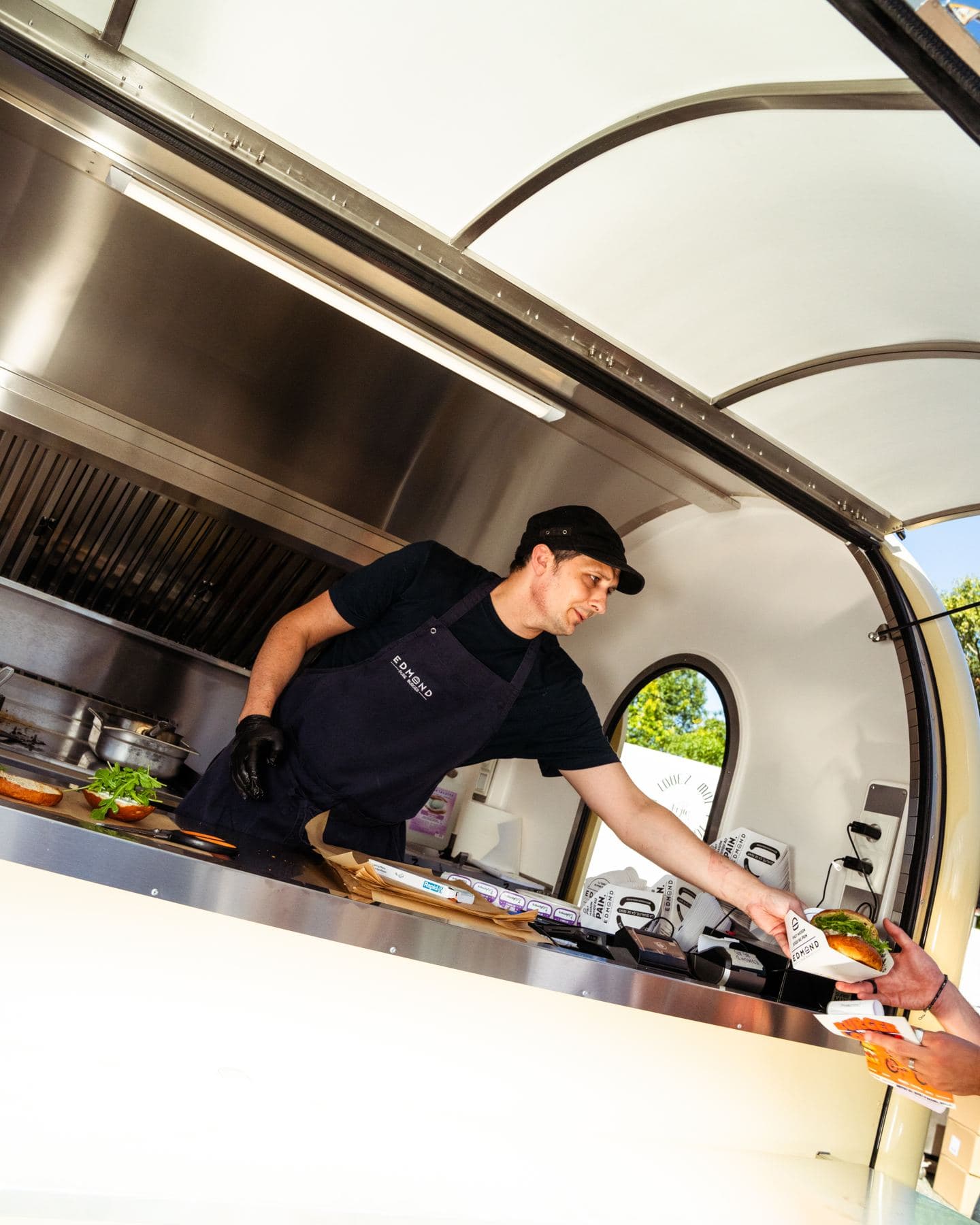
Check your car, then the paperwork.
At 750 kg, the AIR 220 can be towed on a category B licence (Directive 2006/126/EC, art. 4(4)(b)), provided your car is allowed to tow 750 kg unbraked (Ireland VRC). The FTS Academy checks what your car can tow.

Registration, country by country.
- IrelandNo registration or motor tax up to 3,500 kg: it carries a plate with the towing car’s number, and the speed limit is 80 km/h.
- SpainNo registration up to 750 kg, but it has its own ITV card, carried with the towing car’s documents.
- Nordic countriesRegistered, with its own number plate, in Denmark, Sweden, Finland and Norway, even at 750 kg.
- Italy and PortugalRegistered, with its own plate and insurance, even at 750 kg.
Where to keep a 262 cm trailer.
At 262 cm high, it will not fit under every door: measure the garage door, the gate and the ceiling of any covered car park. Otherwise, a secure yard, a shed or a caravan storage site will do, with a hitch lock.
Small on the outside, a real kitchen inside.
The AIR 220 lets you start small without giving up on cooking, from €11,500 excl. VAT as an Essentiel and €13,495 as a Chef+. See our food truck trailers, or read what a 750 kg food truck trailer means for your licence.
One axle, no engine, a real kitchen.
Your questions answered.
Got another question? Just ask us ›A compact food outlet: a food cart, a motorised three-wheeler, a small van or a small trailer. The right choice depends on what your menu needs in terms of cooking, water, refrigeration and power.
The AIR 220 is unbraked, with a maximum authorised mass of 750 kg, so your car must be allowed to tow 750 kg unbraked: check its registration certificate (field O in Ireland) or the owner’s manual. A category B licence is enough.
It depends on your country. Not in Ireland, nor in Spain up to 750 kg, although there it needs its own ITV card; yes in Denmark, Sweden, Finland, Norway, Italy and Portugal, even at 750 kg.
If you want a new one, our small food truck trailer is the AIR 220, from €11,500 excl. VAT, delivered with a European Certificate of Conformity. It suits a team of one or two at markets and events, a mobile coffee shop or a first food truck. If you buy second-hand, check the paperwork, the gas installation, the body and the axle before you pay.
The Essentiel leaves two spaces for your own fridges (not supplied), while the Chef+ has a 130 cm extractor hood and a double-door fridge. The Frost has a 7-tub ice cream display, and the Barista a bottle fridge and room for your coffee machine.
Essentially none: both mean a small mobile food outlet. A van has its own engine; a small trailer has none, and stays on the pitch while you drive the car away.
 By Romain, founder