Food truck dimensions: size, weight and drawings
The actual measurements of a food truck trailer, what they mean for the way you work, how much space to allow on a pitch, and dimensioned plans to download.
 Romain BarreauFounder of Food Truck Store · 5 min read
Length, width, height and maximum authorised mass: food truck dimensions shape everything else, before you even think about colours or the menu. They decide how many people can work inside, where you can trade and where the trailer is kept at night. Here are the measurements of our two formats, what they mean in practice and how much space to allow around them.
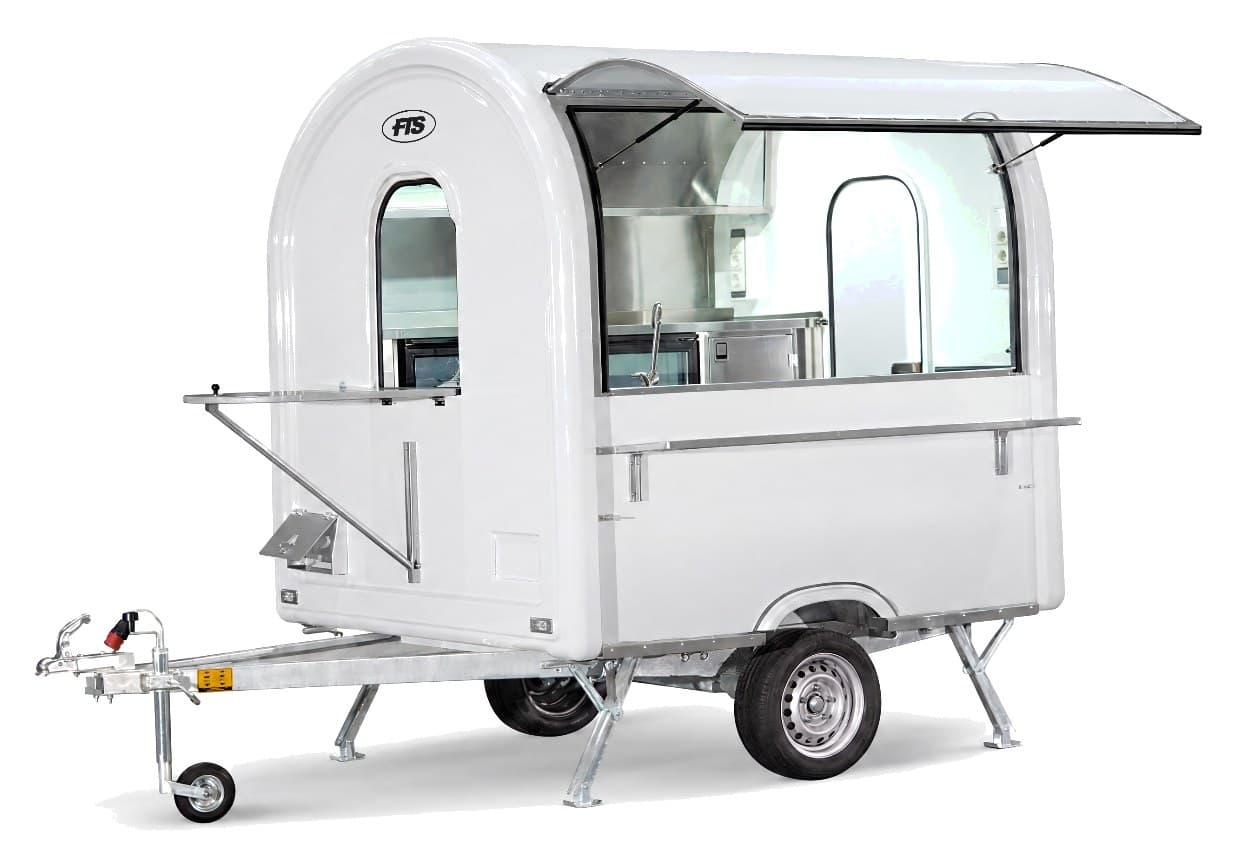
The measurements of our two formats.
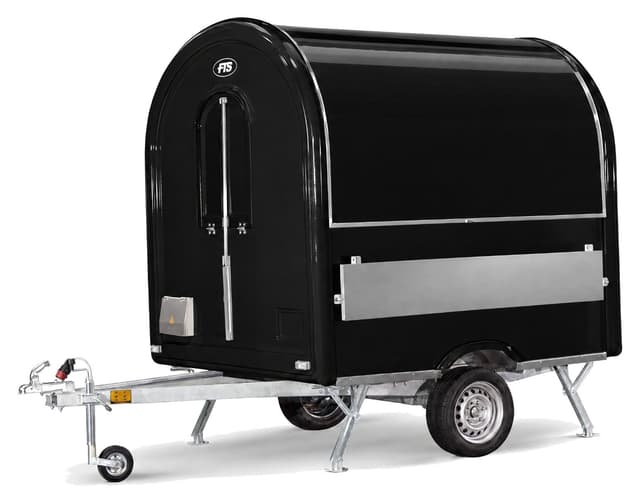
Our trailers come in two formats, named after the length of the body: 220 or 270 cm. The AIR 220 is 361 cm long including the drawbar, 203 cm wide and 262 cm high, with 211 cm of headroom inside; the BOLD 270 is 419 cm long, with the same width and height. In metres, that is 3.61 or 4.19 m long, 2.03 m wide and 2.62 m high.
The AIR 220: 361 cm long with the drawbar, 203 cm wide, 262 cm high.
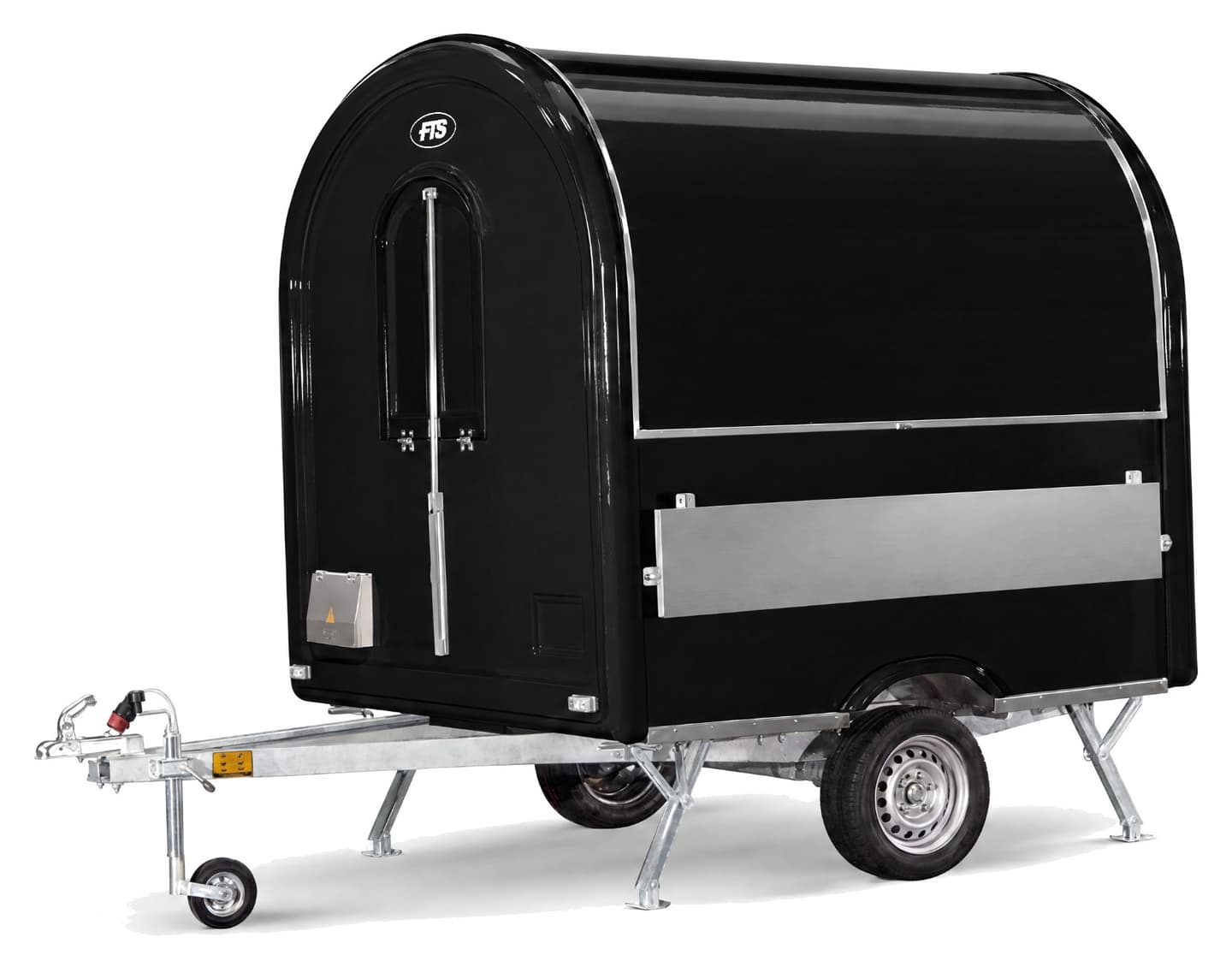
What an extra 50 cm gives you.
The BOLD 270 has the same width and height as the AIR 220: the difference is 50 cm of extra body length. That space goes on cooking, worktops and refrigeration, and so on the stock you can carry.
- 1 to 2people working in the AIR 220
- 2 to 3people working in the BOLD 270
- 180 cmextractor hood in the BOLD 270 Chef+, compared with 130 cm in the AIR 220
- 200 cmthree-door fridge in the BOLD 270 Chef+, compared with 150 cm in the AIR 220
How much space a pitch needs.
At a market or event, the trailer takes up only part of the pitch: allow for the queue, access and sometimes the car, and include these measurements in your application. Pitch size also affects rules and fees: in County Kildare, the annual casual trading fee depends on the pitch, which can be up to 3 m, 3 to 6 m or 6 to 9 m long by 3 m deep, including vehicle space where permitted (Kildare County Council). In Helsinki, a sales vehicle or trailer may be no more than 3 m wide and 8.5 m long (City of Helsinki, mobile sales guide).
- The trailer itself
361 × 203 cm for the AIR 220 and 419 × 203 cm for the BOLD 270, including the drawbar.
- Queue space at the hatch
The serving hatch faces your customers, so leave room in front of it for a queue.
- Access at the back
The door is at the back: leave room to get in and out and to unload stock.
- The car
Once unhitched, it can be parked elsewhere; if it stays beside the trailer, add its length.
- The extras
An awning, tables, a generator: each takes up space, so mention it in your application.
Weight: the figure on the paperwork.
The weight that matters is the maximum authorised mass: 750 kg for the unbraked AIR 220, and 1,000 or 1,500 kg for the braked BOLD 270. It determines the licence you need and which car can tow it: a category B licence covers a trailer of up to 750 kg, or a heavier one as long as car and trailer together come to no more than 3,500 kg; above that, you need code 96 or a BE licence, depending on your country (Directive 2006/126/EC, art. 4(4)). Everything you load, including water, stock and gas, has to stay within that mass.
- AIR 220, 750 kgUnbraked: a category B licence, and a car rated to tow 750 kg unbraked.
- BOLD 270, 1,000 kgBraked: category B, provided car and trailer together come to 3,500 kg or less.
- BOLD 270, 1,500 kgBraked: category B, code 96 or a BE licence, depending on your car and country.
Driving and parking with a trailer.
Once hitched, the trailer adds to the length of your car: 361 cm more with an AIR 220, or 419 cm with a BOLD 270. Both formats are 262 cm high, so keep that figure in mind at bridges, height barriers and multi-storey car parks, as well as at your own garage door. In Copenhagen, a trailer with a number plate counts as a large vehicle and may only stand in parking spaces, so you park your car somewhere else (City of Copenhagen).
Check the plans before you sign.
To compare on paper, our comparison page has a dimensioned PDF plan of each layout with the equipment numbered, and a 3D view lets you step inside. Use them to fit your own appliances in before you choose.
The free FTS Academy quiz starts from your menu and tells you which layouts and formats to compare, and why.
Let your service decide the size.
Pick the format for the way you serve, not because more space sounds nice. Working alone or as a pair, the AIR 220 is enough; with two or three people and high volumes, the BOLD 270 comes into its own. See our food truck trailers, or read our guides to the mini food truck and the 750 kg food truck trailer.
The rush shows whether the size is right.
Your questions answered.
Got another question? Just ask us ›At Food Truck Store, the AIR 220 is 361 cm long including the drawbar, 203 cm wide and 262 cm high; the BOLD 270 is 419 cm long, with the same width and height. The body you work in is 220 or 270 cm long.
The AIR 220 measures 3.61 × 2.03 × 2.62 m (length with drawbar, width, height), with 2.11 m of headroom inside; the BOLD 270 measures 4.19 × 2.03 × 2.62 m.
The AIR 220 suits one or two people, the BOLD 270 two or three. If two of you work every day on high volumes, the BOLD’s extra 50 cm go on cooking, refrigeration and worktop space.
The figure that counts is the maximum authorised mass shown in the trailer’s papers: 750 kg for the AIR 220, and 1,000 or 1,500 kg for the BOLD 270. It decides the licence you need, the brakes and which car can tow the trailer.
On our comparison page and on each model page, you’ll find a dimensioned PDF plan of each layout and a 3D view you can step inside.
Both our formats are 262 cm high, so the door of your garage, shed or car park needs to clear that. Measure before you buy, not on delivery day.
 By Romain, founder