Food truck financing with little or no savings
Start-up loans, public guarantees and benefits you can keep while you get going: how to finance a food truck without savings, starting with Ireland, each with its official source.
 Romain BarreauFounder of Food Truck Store · 6 min read
Food truck financing with little or no savings is possible, but not by walking into a bank with nothing to show. Without savings, you put the money together from several sources: a start-up loan, a public guarantee, and a benefit you keep while you get going. Here is each one, Ireland first, with its official source.
Start with a trailer, not a truck.
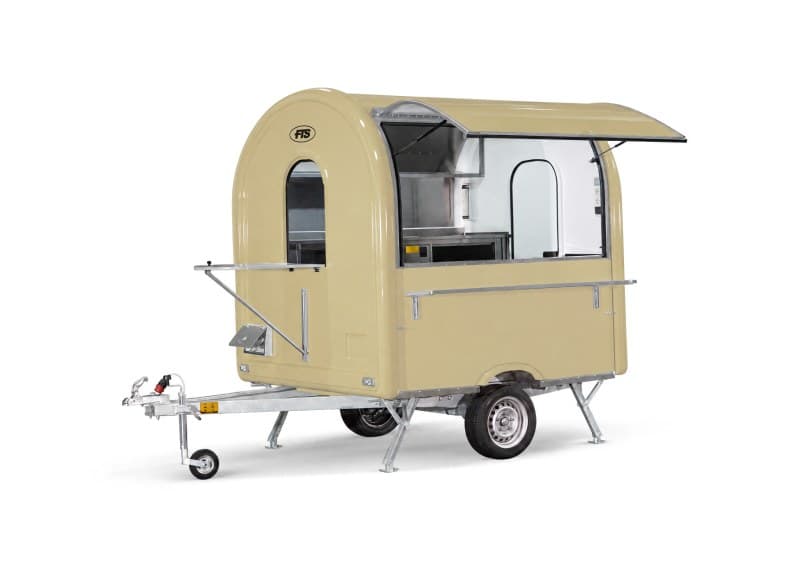
The smaller the investment, the less money you need to raise. A fitted food truck trailer from Food Truck Store starts at €11,500 excl. VAT; the 750 kg AIR 220 can be towed on a category B licence, within your car’s towing capacity, and has no engine to wear out. Appliances, stock, insurance and permits come on top: our guide How much does a food truck cost? lists every item.
Ireland: start with Microfinance Ireland.
Microfinance Ireland lends to start-ups with no trading history, in amounts that cover the price of any trailer in our catalogue, and makes a credit decision within 10 business days of a complete application (Microfinance Ireland). Apply through your Local Enterprise Office and the rate is 5.5% APR instead of 6.5%; LEO grants themselves may not be open to you, as LEO Sligo lists mobile food outlets among the businesses its grants do not fund (LEO Sligo). Your application is judged on your business plan, your ability to repay and the viability of the idea.
- Talk to your LEO
For advice, and to apply to Microfinance Ireland at the lower rate.
- Write your plan
Your business plan, plus a month-by-month cash flow forecast.
- Send a complete application
Application form, cash flow forecast and some personal financial information.
- Get a decision
Within 10 business days of a complete application.
Keep your benefit while you start up.
In Ireland, the Back to Work Enterprise Allowance lets you keep 100% of your social welfare payment in the first year and 75% in the second, after 9 months on a jobseeker’s or other qualifying payment, once a case officer and a Local Development Company have approved your plan (gov.ie). Other countries have their own versions: the starttiraha in Finland (Työmarkkinatori), Arbetsförmedlingen’s start-up support in Sweden (Arbetsförmedlingen), and unemployment benefit kept for up to 12 months in Norway (National Insurance Act, section 4-6) or paid as a lump sum in Spain (SEPE) and Portugal (IEFP).
- FinlandStarttiraha for 6 months, up to 12 in total: apply before you start full time.
- SwedenSix months of start-up support for registered jobseekers, with an approved business plan and budget.
- NorwayUnemployment benefit kept for up to 12 months while you prepare and launch your business.
- Spain and PortugalUnemployment benefit paid as a lump sum to set up as self-employed, subject to conditions.

Public guarantees: your bank applies.
When the bank wants more security than you can offer, a public guarantee covers part of the loan. In Finland, the Finnvera Start Guarantee covers up to 80%, and Finnvera requires no contribution of your own (Finnvera); in Denmark, EIFO covers 80% of the final loss on a guaranteed bank loan (EIFO); in Spain, the state-owned CERSA reinsures up to 80% of the guarantees given by the regional mutual guarantee societies (CERSA). In Italy, the SME Guarantee Fund backs microcredit for small sole traders with no collateral required, and support services are compulsory (Fondo di garanzia).
In Finland and Denmark, your bank applies for the guarantee, not you; in Spain, you go to your regional mutual guarantee society. Ask your adviser directly whether your loan can be guaranteed.
Microloans and start-up schemes.
In Sweden, an Almi microloan normally needs no co-financing and only a limited personal guarantee, and is backed by the European Investment Fund under InvestEU (Almi). In Portugal, the IEFP’s Microinvest line gives the unemployed, young people seeking a first job and low-income self-employed people access to bank credit with a mutual guarantee and subsidised interest (IEFP). In Italy, Invitalia runs Resto al Sud 2.0 in the southern regions and Autoimpiego Centro-Nord elsewhere, for young people who are out of work or on low pay, subject to conditions (Resto al Sud 2.0, Autoimpiego Centro-Nord).
The loan gets you started; the work does the rest.
What lenders want to see first.
In Norway, the official business portal warns that the bank will ask for security and expect a solid business plan, realistic budgets and proof of demand, with equity of 20 to 35% of the amount you need, which can include valued equipment and documented work of your own (Altinn). Almi asks for a budget and a cash flow forecast; Microfinance Ireland asks for a cash flow forecast. The free FTS Academy business plan works out your investment, fixed costs and break-even point, ready for that meeting.
No savings, but solid figures.
Applications without savings rarely fail for lack of money; they fail for lack of figures. A cautious forecast, a pitch already lined up, a short menu with costed margins and a trailer of the right size convince lenders more than a bank balance. Compare our food truck trailers and read how much money food trucks make.
Real figures start at the counter.
Your questions answered.
Got another question? Just ask us ›Yes, by combining several sources: a start-up loan such as Microfinance Ireland, a public guarantee requested by your bank where your country offers one, and a benefit you keep while you start up, such as the Back to Work Enterprise Allowance in Ireland. A short, costed business plan is what holds it all together.
A lender to small businesses, including start-ups with no trading history. It decides within 10 business days of a complete application, at 5.5% APR through a Local Enterprise Office or 6.5% directly.
LEO Sligo excludes retail businesses from its grants and names mobile food outlets among them, so check the rules of your own Local Enterprise Office. LEOs still offer advice and access to the lower Microfinance Ireland rate, and the Back to Work Enterprise Allowance can support your income.
In Ireland, the Back to Work Enterprise Allowance lets you keep 100% of your payment in the first year and 75% in the second, after 9 months on a qualifying payment. Finland, Sweden and Norway have their own schemes, and Spain and Portugal can pay the benefit as a lump sum.
A solid business plan, realistic budgets and a cash flow forecast, and often security or equity. In Norway, the official business portal advises equity of 20 to 35% of the amount you need.
 By Romain, founder