Food truck VAT and business structure
VAT rates by product in Ireland and across Europe, small business thresholds, sole trader or company: the official sources, plus the questions to ask your accountant.
 Romain BarreauFounder of Food Truck Store · 5 min read
Food truck VAT depends on your country, on what you sell and sometimes on where your customers eat it. In Ireland, hot take-away food has been taxed at 9% since 1 July 2026, while ice cream, soft drinks and alcohol are taxed at 23%. Whether you trade as a sole trader or a company is a separate decision. This guide sets out the official rates and the questions to take to your accountant; it is not personal tax advice.
Irish VAT treats take-away food as goods.
For Irish VAT, take-away food and drink sold from a mobile snack bar is generally a supply of goods, not a catering service (Revenue, Tax and Duty Manual). Since 1 July 2026, hot take-away food and hot tea and coffee have been charged at the second reduced rate of 9% (Revenue). Cold food, cakes, ice cream, soft drinks and alcohol each have their own rate, and a meal deal that includes a soft drink at a single price has to be split between the rates (current VAT rates).
- 9%hot take-away food, hot tea and coffee, since 1 July 2026
- 0%cold food and cold sandwiches to take away
- 13.5%cakes and biscuits without chocolate
- 23%ice cream, soft drinks, bottled water and alcohol
Each product has its own rate.
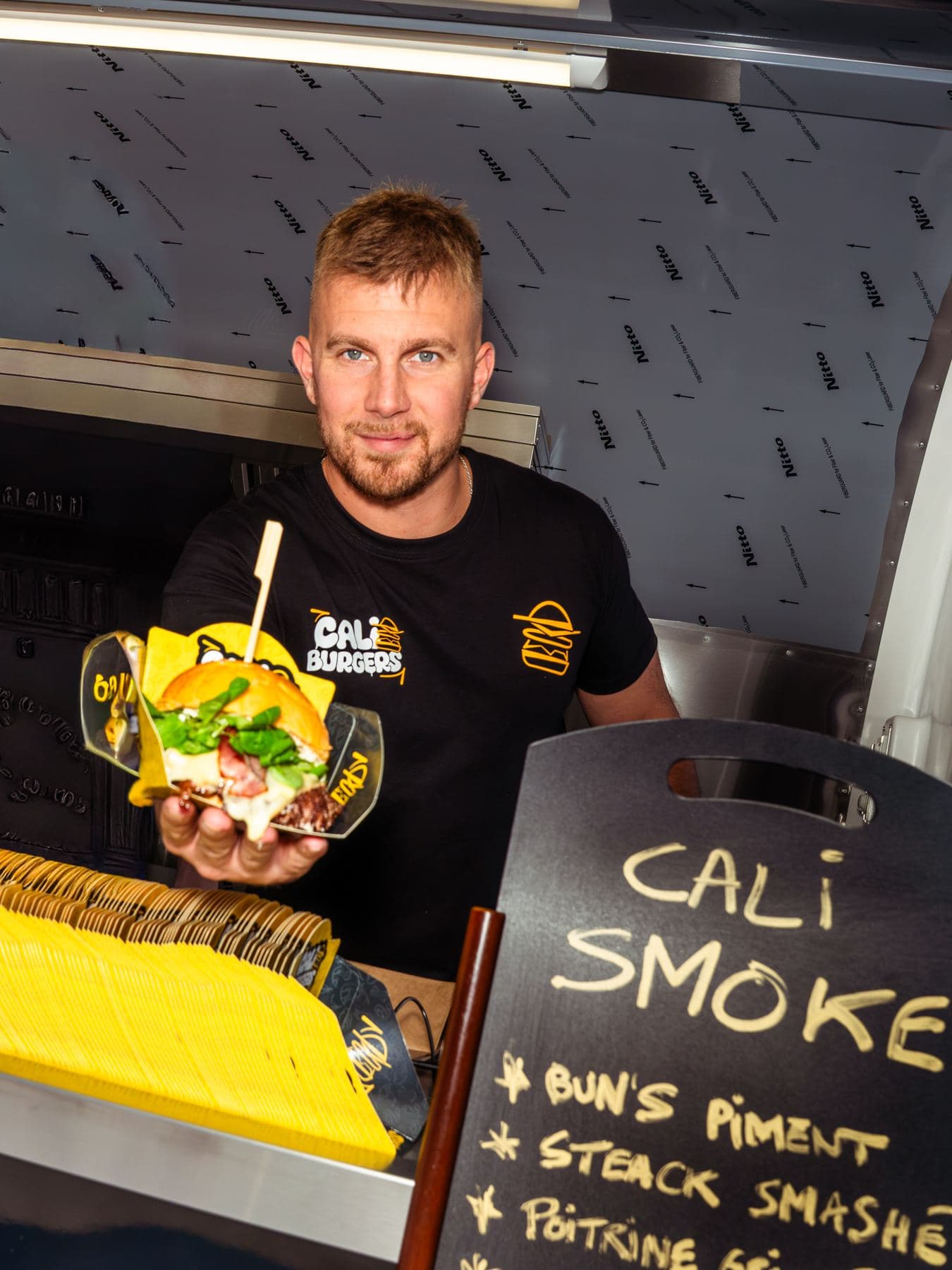
In Ireland, most of what a hot food trailer sells, such as burgers and chips or take-away coffee, is at 9%. A Frost selling ice cream charges 23%, and a Barista mixes 9% coffee, 13.5% cakes and 23% cold drinks. Set your till to apply the right rate to each item, and work out your menu prices excluding VAT, because that is the money that pays your costs.
One menu, several VAT rates.
Rates vary from country to country.
Every country sets its own rates and its own rules for take-away food (Denmark, Sweden, Norway, Finland, Spain, Italy, Portugal). In Sweden and Norway, putting out tables and chairs can push your sales into a higher rate; in Denmark, a single rate covers everything.
- Denmark25% on everything a food truck sells, whether it is taken away or eaten on the spot.
- Sweden and NorwayTake-away food is 6% in Sweden until 31 December 2027 and 15% in Norway, higher with tables and chairs; wine, spirits and strong beer are 25%.
- Finland13.5% on food and soft drinks, whether taken away or eaten on the spot; 25.5% on alcohol.
- Spain, Italy and PortugalPrepared food is 10% in Spain and Italy and 13% in Portugal; in Spain and Portugal, alcohol and some soft drinks are taxed at a higher rate.

The small business exemption cuts both ways.
Below a certain turnover, a small business can stay outside VAT: you charge none, but you cannot reclaim any on your purchases either, including the trailer. The thresholds below come from Skattestyrelsen, Skatteverket, the Norwegian VAT Act and Vero; in Ireland, Revenue publishes several thresholds, depending on what you supply (Revenue). Ask your accountant which one applies to your food truck.
- DKK 50,000per calendar year: above this, a Danish business must register for VAT
- SEK 120,000per year: up to this, a Swedish business can stay exempt
- NOK 50,000over 12 months: the Norwegian registration threshold
- €20,000per year: up to this, a Finnish business can stay exempt
Sole trader or limited company.
In Ireland, a sole trader registers with Revenue for self-assessment, and PRSI registration follows automatically (Citizens Information); if you trade under a name other than your own, you also register a business name with the CRO (CRO). A limited company is registered with the CRO and pays corporation tax at 12.5% on trading profits (Revenue). Other countries offer the same choice under other names: enskild firma or aktiebolag in Sweden, autónomo or sociedad limitada in Spain (verksamt.se, Law 18/2022).
- Register with Revenue
As a sole trader, register for self-assessment; PRSI registration follows.
- Register a business name
With the CRO, within a month, if you trade under a name other than your own.
- Or form a company
Register it with the CRO; it pays corporation tax at 12.5% on trading profits.
- Check VAT registration
Go through the thresholds published by Revenue with your accountant.
Good habits from day one.
VAT on the trailer itself.
Our prices are shown excluding VAT, and your quote shows the VAT that applies to your purchase, which depends on your status and your country. A VAT-registered business can generally reclaim the VAT on its business purchases. Under a small business exemption, or Italy’s flat-rate scheme (the regime forfettario), that VAT becomes a cost (Law 190/2014, art. 1).
Sort out your menu before you see the accountant: the free Academy quiz finds the right layout for your concept, and our guide to what a food truck costs lists every item, excluding VAT.
Choose before your first sale.
You choose your structure when you register, and changing it later costs time and money, so see an accountant before your first sale. Then read how to start a food truck business and browse our food truck trailers, from €11,500 excl. VAT.
Get your structure right before the first service.
Your questions answered.
Got another question? Just ask us ›Take-away food from a mobile snack bar is generally a supply of goods. Hot take-away food and hot tea and coffee have been at 9% since 1 July 2026; cold food is at 0%, cakes at 13.5%, and ice cream, soft drinks, bottled water and alcohol at 23%.
Yes, once you go over your country’s threshold. In Ireland, Revenue publishes several thresholds depending on what you supply, so check with your accountant which one applies before your first sale.
A sole trader registers with Revenue for self-assessment, and PRSI follows; a limited company is registered with the CRO and pays corporation tax at 12.5% on trading profits. Your accountant can compare the two using your own figures.
In some countries, yes. In Sweden, tables and chairs can move sales from 6% to 12%, and in Norway from 15% to 25%. In Denmark, a single 25% rate covers everything.
If your business is registered for VAT, it can generally reclaim the VAT on its business purchases. Under a small business exemption, or Italy’s flat-rate scheme, it cannot, and that VAT becomes a cost.
No. We give you the official rates and their sources; your accountant applies them to your situation, your menu and your country.
 By Romain, founder